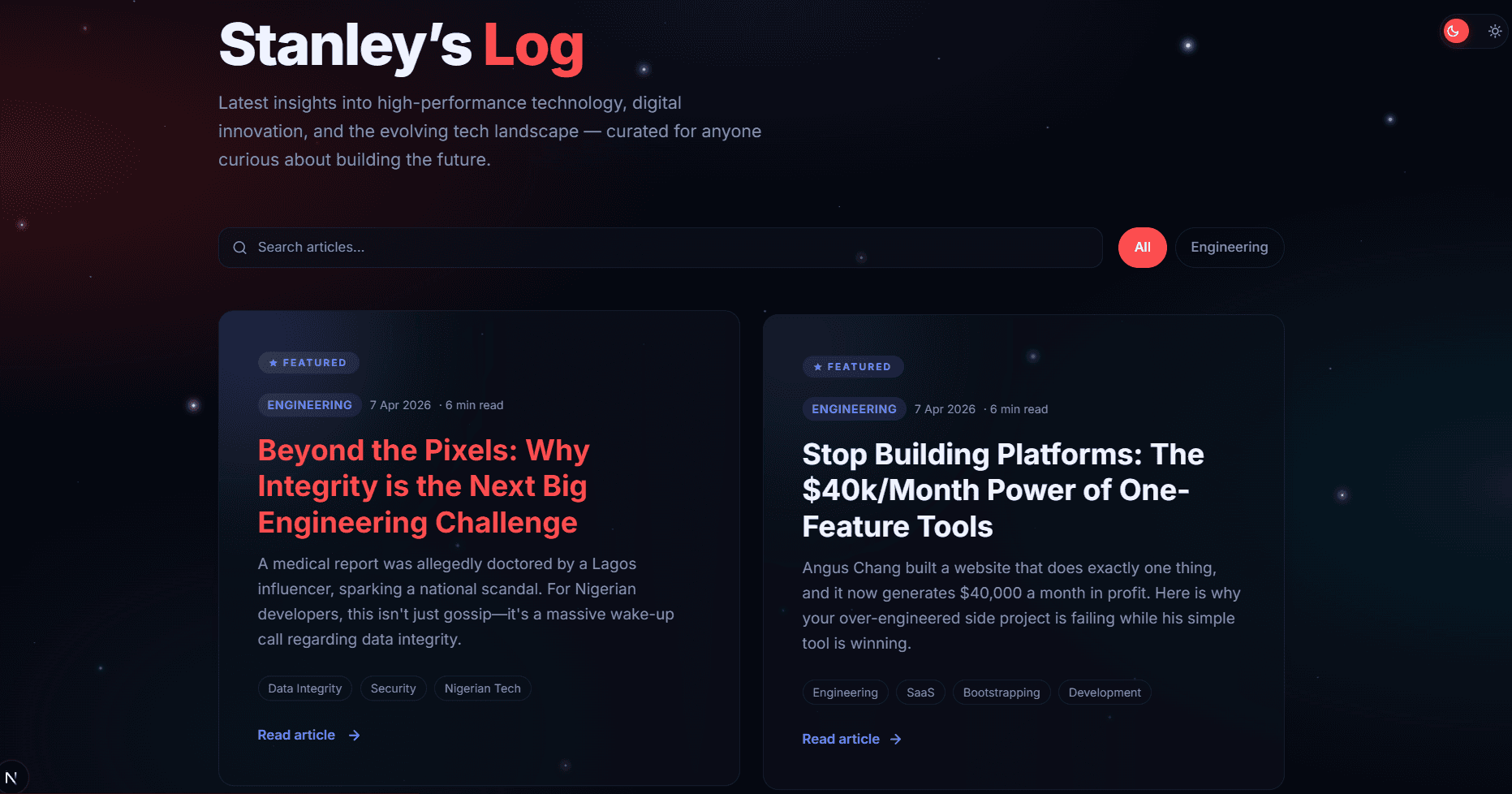
Executive Summary
Managing multiple client deployments, tracking SSL expirations, intercepting runtime JS crashes, and publishing technical research typically require fragmented third-party SaaS tools, high monthly subscription costs, and manual monitoring.
Citadel OS unifies real-time client health telemetry (/monitor-sdk.js), an interactive PROmonitor virtual workspace (/os) with SRE AI diagnostics via Gemini, automated GitHub repository syncing, and an autonomous AI publishing engine into a single Next.js 16 platform with zero external SaaS dependencies.
Core Capabilities & System Highlights
PROmonitor Virtual Workstation (/os)
A fully responsive, windowed desktop workspace housing an Uptime Monitor, Log Terminal, Client Registry, Webhook Alert Manager, and SRE AI Diagnostics Engine.
Automated Telemetry SDK (/monitor-sdk.js)
A lightweight client SDK script capturing page view transitions, click breadcrumbs, console warnings/errors, and window-level crash stack traces.
SRE AI Diagnostics Engine
Analyzes client-side JavaScript crash stack traces using Gemini LLMs to generate instant root-cause summaries and step-by-step code repair recommendations.
Webhook Alert Pipeline
Dispatches instant alerts to configured Discord or Slack channels when client target sites experience offline downtime or fatal exceptions.
System Architecture & Specs
Next.js 16 App Router & Draggable Window Manager
React 19 Server Components with Turbopack for sub-100ms render times, combined with desktop glassmorphism window management and responsive mobile fallbacks.
Server Actions & Telemetry API Middleware
Type-safe REST endpoints and Next.js Server Actions handling client pings, log ingestion, and GitHub Webhook synchronization.
PostgreSQL & Prisma Client Schema
Relational database schema storing client site records, telemetry execution logs, post metrics, and GitHub repository state with transactional safety.
GitHub Actions & Cron Workflows
Automated daily crons executing headless scrapers, multi-model AI synthesis, and direct repository commits for immutable post history.
Key Engineering Trade-offs & Operational Notes
Portfolio presentation, client health monitoring, and AI content creation share a single codebase while maintaining strict modular separation.
Published articles and project listings remain version-controlled in Git, ensuring every edit has a clean historical audit trail.
The AI generation pipeline seamlessly switches between LLM models if a primary endpoint experiences throttling.
Tech Stack & Role Matrix
Every library and framework in Citadel OS (Portfolio & Control Plane) was chosen with intentional architectural trade-offs to balance speed, type safety, security, and scalability.
| Technology | Category | System Role | Performance Rationale |
|---|---|---|---|
| Next.js 16 | Framework | Full-Stack App Router & Server Components | Delivers maximum rendering performance, instant static generation, and unified edge API routes. |
| TypeScript | Language | End-to-End Type Safety | Eliminates runtime errors across database models, API payloads, and component props. |
| Prisma ORM | ORM | Database Access Layer & Migrations | Provides type-safe queries and automated migration scripts for PostgreSQL. |
| PostgreSQL | Database | Relational Data Store | Stores client sites, diagnostic logs, post metrics, and GitHub sync records with ACID compliance. |
| Gemini AI | AI / ML | SRE Diagnostics & Automated Content | High-speed LLM inference with structured JSON output and cost-effective multi-model fallback. |
| TailwindCSS v4 | UI Library | Modern Styling Engine | Provides zero-runtime utility styling and custom CSS design tokens for dark/light themes. |
Live Preview & Showcase
Metrics & Reliability
Uptime SLA
Continuous HTTP & SSL diagnostic ping checks across client sites
Render Latency
Server Component static generation with Turbopack compilation
Telemetry Overheads
Ultra-lightweight asynchronous client monitoring SDK script