The Physics of Uptime: Why Choosing Between MTN 5G and FibreX is an Infrastructure Trap
The battle between MTN's 5G router and FibreX isn't about download speeds. It is about how engineering teams survive the intersection of physical cable cuts, battery runtimes, and local grid failure.
If you run a remote product team out of a duplex in Gbagada or push code from a home office in Akure, you already know the unwritten rule of Nigerian engineering: you do not write software in an abstract cloud. You write software constrained by the state of local roads, the national power grid, and radio wave congestion.
When telecom reviews pitch the MTN 5G Router against MTN FibreX, they frame it as a typical consumer decision: do you want portability, or do you want raw, unmetered fixed-line throughput?
The interesting thing about this story is not merely wireless speeds versus fixed-line megabits. It is actually how African technical founders are forced to design fault-tolerant, high-availability physical topologies just to maintain a basic CI/CD pipeline.
Treating this choice like an ordinary consumer pick is a mistake. Both systems solve different operational problems, and picking the wrong one—or assuming either can stand alone—creates an immediate single point of failure for your business.

The Economics of Two Pipes
Look at the underlying mechanics.
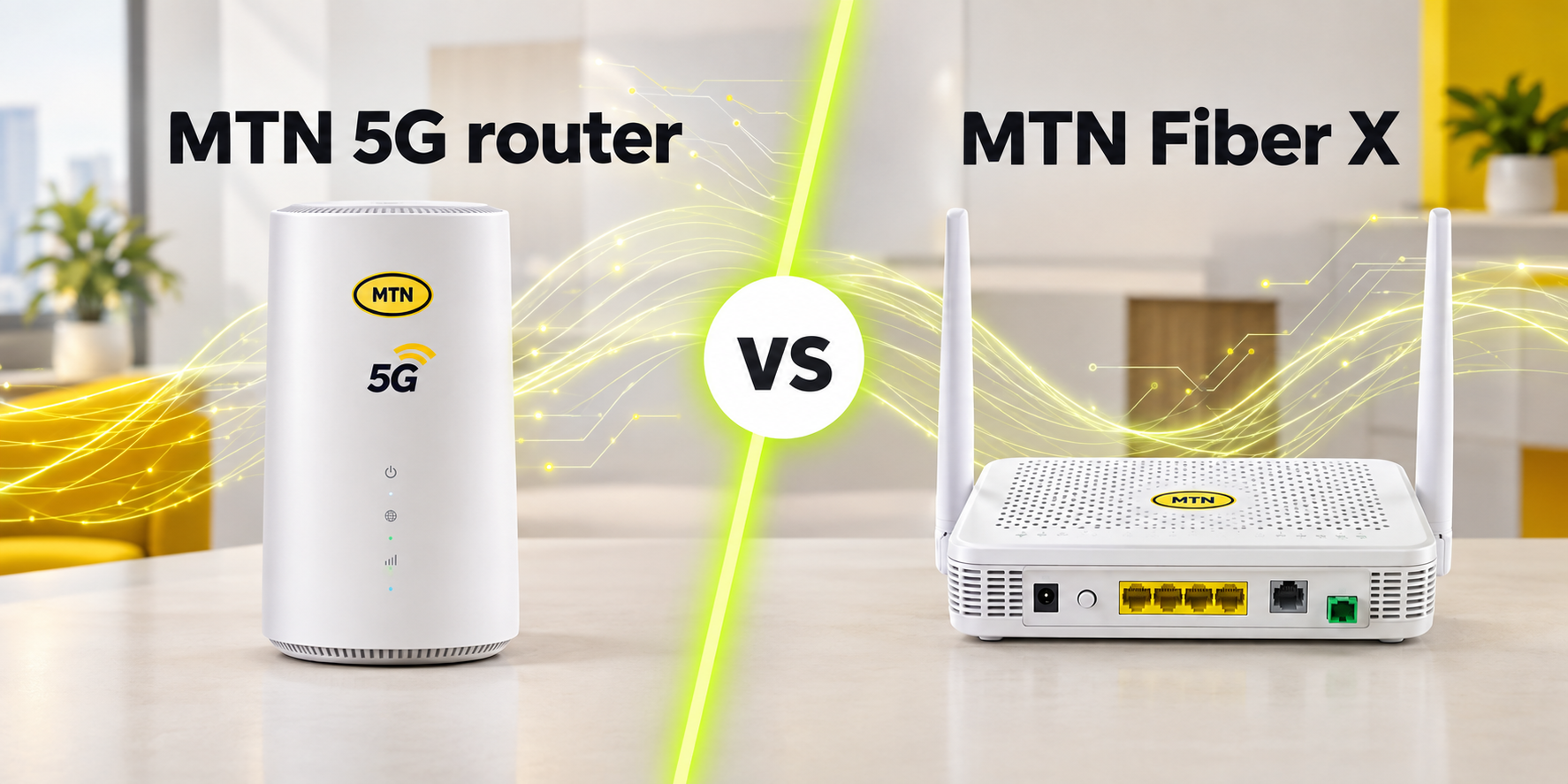
The MTN 5G Router retails at ₦80,000 upfront. It ships with a 100GB welcome package, zero trenching requirements, and an internal battery rated for roughly 4.5 hours of independent life. It is mobile broadband masquerading as home infrastructure.
FibreX, by contrast, removes the upfront hardware purchase barrier in covered areas—handing you an Optical Network Terminal (ONT) at no extra hardware fee, asking only for subscription capital. In return, it promises dedicated, low-latency, unthrottled fiber-optic throughput directly into your router's WAN port.
On paper, FibreX looks like the obvious choice for any serious startup team. Fibre-optic glass does not care about torrential downpours. It does not suffer from high packet jitter when every kid on your street starts streaming 4K YouTube clips at 8:00 PM. The speed you contract for is the speed the optical light pulses deliver.
Then reality strikes.
Fibre-optic infrastructure in Nigeria exists in perpetual war with civil construction. A Lagos State drainage trenching team, an errant diesel tanker, or an unannounced road widening project in Lekki can sever your physical line without warning. When a physical fiber cable snaps, your ISP does not fix it with a software patch. They send a field crew with a fusion splicer. In dense urban sprawls, that means hours—sometimes days—of dead silence.
Worse: the FibreX ONT box has zero internal battery reserves. The second the disco cuts the grid and your inverter hesitates during the transfer phase, your gateway drops.
The 5G router, conversely, trades bandwidth determinism for resilience. It is locked to radio spectrum constraints. In the evening, when base transceiver stations (BTS) get hammered by mobile subscribers, your upstream packet loss spikes. But it has a 4.5-hour lithium-ion buffer, requires zero physical wires through your compound wall, and can be tossed into a backpack if you have to flee a neighborhood-wide blackout.

The Founder Directive
If you are an operator making procurement decisions for your team, home office, or co-located hub, stop reading marketing pamphlets. Here is how to evaluate the choice strategically.
The Short Answer
If your work requires determinism—pushing large builds, real-time client demos, zero-latency gaming development, heavy database syncs, or multi-seat video calls—get MTN FibreX. But do not buy it unless you already have an uninterruptible power supply (mini-UPS) dedicated to the ONT box and an active 5G or 4G failover router sitting right beside it.
What Is Really Happening
MTN is running a classic land-grab across two fronts. They are offloading dense, stationary traffic onto their fixed fiber network (FibreX) to decongest their mobile cell towers, using zero-cost installation to pull sticky, high-LTV residential and commercial contracts. Concurrently, they are monetizing their 5G capital expenditure by selling ₦80,000 customer-premise equipment (CPE) to the millions of middle-class renters who move every twelve to twenty-four months and cannot justify waiting for fiber trenching.
The Assumption I'd Challenge
The assumption that pure fiber optic broadband eliminates your connectivity problems.
You may be optimizing for peak megabits per second when you should be optimizing for Mean Time Between Failures (MTBF). High-speed fiber with a 48-hour repair cycle due to street excavation is vastly inferior to a slower, jittery 5G connection that operates continuously through power blips and construction accidents.
The Strategic Options
| Dimension | MTN FibreX (FTTH) | MTN 5G Router (Fixed-Wireless) |
|---|---|---|
| Upfront Friction | Low initial cost (covered areas), high installation wait time. | ₦80,000 upfront purchase; instant plug-and-play setup. |
| Throughput Determinism | High. Consistent speeds regardless of time of day. | Variable. Degrades during peak evening mobile congestion. |
| Power Fault Tolerance | Zero native battery; drops instantly without external UPS. | High; ~4.5 hours internal battery runtime. |
| Physical Vulnerability | Fragile. Subject to road crews, overhead cable cuts, tree falls. | High airwave resilience; vulnerable only to tower downtime. |
| Portability / Tenancy | Zero portability. Bound to the physical address. | High. Relocates immediately to any 5G-covered zone. |
My Recommendation
- For Remote Founders & Senior Engineers: Run a dual-WAN setup. Make MTN FibreX your primary pipe for raw speed, deterministic uploads, and clear video latency. Connect it through an automated multi-WAN router (like a cheap MikroTik or TP-Link Omada). Put the MTN 5G Router on your secondary WAN interface as a hot standby.
- For Early-Stage Renters & Bootstrapped Teams: Do not wait for fiber rollout if you are renting an apartment on a short lease. Buy the 5G Router. The portability gives you operational agility. If your landlord decides to hike the rent by 80% next year, you do not abandon sunk installation investments; you pack your gateway in a bag and keep shipping.
What I Would Do Next
- Audit your power supply first: Before ordering FibreX, buy a dedicated DC mini-UPS (costing roughly ₦15,000 to ₦25,000) that can power the 12V ONT box directly, isolating it from inverter transfer spikes.
- Check 5G Cell Saturation: Before spending ₦80,000 on the 5G router, run repeated speed tests on an MTN 5G mobile device inside your exact working room at 2:00 PM and 8:30 PM. If the evening latency spikes beyond 120ms or drops more than 60% in throughput, that local base station is oversubscribed; look elsewhere or settle for fiber.
What Would Change My Mind
- SLA Enforcement on Fiber Cuts: If MTN or infrastructure partners guarantee a 4-hour Mean Time to Repair (MTTR) with automated credit refunds for broken street lines, fiber becomes an unquestioned sole primary choice.
- 5G Network Slicing: If MTN introduces true consumer-level network slicing or prioritized Quality of Service (QoS) tiers on their 5G routers—protecting business traffic from residential evening streaming congestion—the operational argument for physical fiber diminishes significantly. Until then, you are engineering around physical fragility on one side, and spectrum congestion on the other.
Related from Nigeria
Let's build your next big product.
Accepting project-based freelance, remote engineering roles, and hybrid positions.