Green Tests, Red Flags: When Your Automated Checks Lie (And What to Do About It)
Your green CI pipeline? It might be telling you half-truths. A solo dev's journey reveals a chilling reality: we often measure proxies, not actual user experience. The strategic takeaway for founders isn't just better tests, it's a brutal re-evaluation of what 'done' means for your product and business.
Let's talk about that warm, fuzzy feeling you get when your CI pipeline lights up green. That little dopamine hit that tells you, "Alright, one less thing to worry about. Ship it."
Dedemavci, the solo dev behind Pixbu, a self-care app with a growing pixel creature, got that feeling 1,889 times from their automated tests. But as the story unfolds, it's clear that green light was often less a badge of honor and more a silent saboteur, measuring everything except the thing that truly mattered. This isn't just a coding anecdote; it's a strategic gut punch for any founder, builder, or developer trying to bring a product to life.
The Problem: We Build for Proxies, Not Reality
What actually happened in Pixbu's world is a masterclass in how easily we can delude ourselves with convenient proxies, especially under the pressure of shipping.
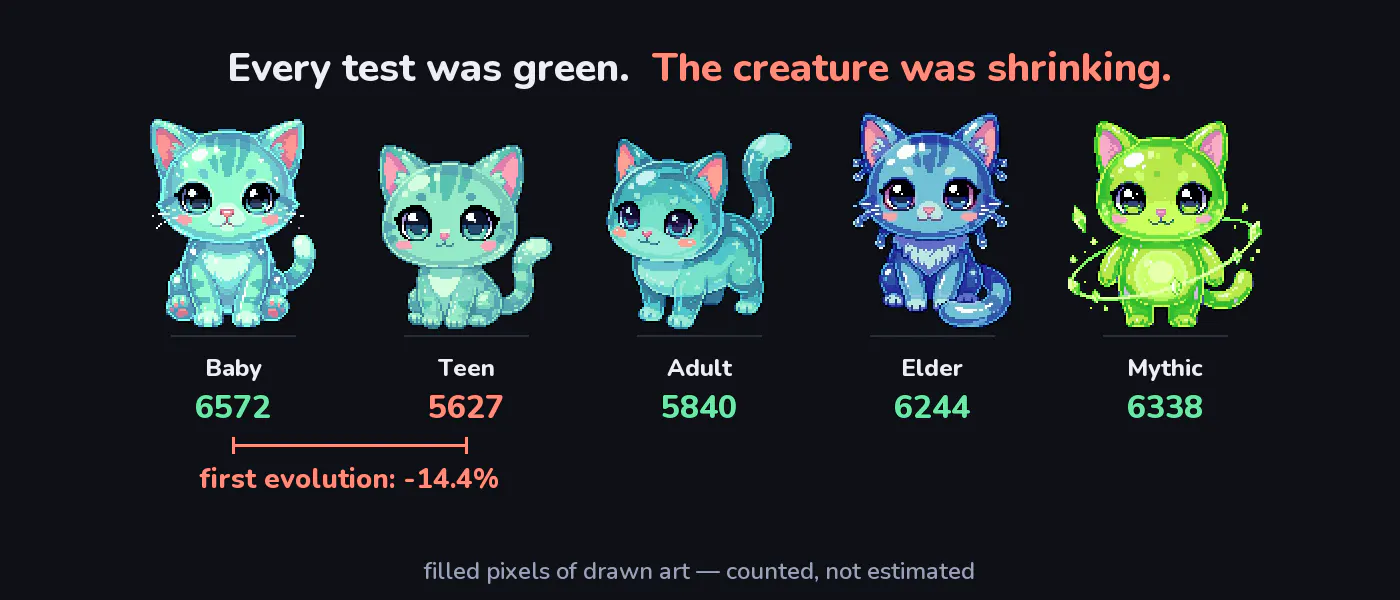
The Shrinking Creature: Pixbu’s core emotional payoff is watching a pixel creature grow. New art, tests still green. Ship it, right? Turns out, the creature was shrinking by 14% at its first evolution. Why? The tests measured metadata about the art files, not the actual pixels rendered on screen. The test wasn't wrong; it was answering a different question. Imagine spending months building a beautiful experience, only for the core delight to literally go backwards. That's a direct hit to PRODUCT and MARKET perception.
Floating Hats and Phantom Skulls: Cosmetics needed to fit creature heads. Tests for bounding boxes showed "no variation." Dead end. But users saw hats floating. The problem? The bounding box included the ears, which were the tallest points. The test was measuring ear tips, not the actual skull where the hat sits. A "null result" was interpreted as "no problem," when it was just evidence the instrument was pointed elsewhere. This isn't just a technical glitch; it's a failure in PRODUCT detail and a drain on OPERATIONS (wasted debugging time).
The Guard Test That Guarded Nothing: A critical function call had a test ensuring it was called. Green for weeks. Then, Dedemavci mutated the source – wrapped the call in
if (false). Test still green. The "guard" was checking if the text of the call existed in the file, not if the code executed. It was a comment disguised as a test. The deeper cut? Even the mutation script to test the test sometimes failed silently due to line-ending mismatches, meaning the verifier's verifier wasn't working. This exposes critical flaws in TECHNOLOGY assumptions and OPERATIONS rigor."There's No Way To Check That" is a Guess: Dedemavci wrote down "no API way to confirm a store update was approved." Reasons seemed individually true. An hour later, signals were found in the HTML of the store page: version string, update date, release notes. Assumptions, even well-intentioned ones, often lead to blind spots. This impacts OPERATIONS and DISTRIBUTION (knowing if your product is live and updated).
One Hiccup Does Not a Capability Make: A single network timeout made Dedemavci conclude they had "no network access" to their git remote. Eight days and 95 commits later, a proper test showed 10 out of 10 connections were fine. A single failed reading, especially in a distributed system, is not a capability assessment. This is a massive hit to OPERATIONS (lost development time) and potentially MARKET opportunity (delayed features). Imagine that happening to a startup in Owerri trying to push critical updates while battling inconsistent network connections. That's not just a bug; it's a week of sapa-inducing stress.


The Strategic Blind Spot: Assuming Green Means Go
The interesting thing about this story is not merely that Pixbu had some faulty tests. It is actually a stark reminder for every founder: your 'green' indicators, whether they are automated tests, user metrics, or internal reports, are only as reliable as the fundamental assumptions and directness of measurement behind them.
We gravitate towards proxies because they're easier to measure. It's simpler to check a metadata file than to programmatically count rendered pixels. It's faster to check if myFunction() exists as text than to instrument and assert its execution. But this convenience comes at a profound cost: building blind.
This isn't just about the technical aspect of writing tests; it's about the very mindset of how we assess the health and success of our ventures. It touches on:
- PRODUCT: Is the user actually experiencing what you designed? Is the core emotional payload landing or falling flat because of something you "tested" but didn't truly measure? The shrinking creature is a perfect example of a foundational product promise failing without a single red light.
- OPERATIONS: The time lost on debugging floating hats, the 8 days of stalled pushes due to a false network conclusion – these are massive operational inefficiencies. In the lean, "no gree for anybody" environment of a startup, every wasted hour is a luxury you can't afford.
- TECHNOLOGY: The very foundation of your software reliability is at stake. If your tests can't fail, they're not tests. If your test-of-the-test fails silently, you've built a house of cards. The insight about verifying your verifier's verifier is pure gold for anyone building robust systems.
The Deeper Cultural Implication: Challenging Our Own Expertise
Dedemavci's candid admission – "whenever I caught myself knowing something about my own app, I measured it instead" – is powerful. It challenges the founder's natural inclination to trust their intuition or knowledge. This isn't just about code; it's about strategic decision-making. How many times do we, as founders, operate on assumptions about our market, our customers, or our competitors, because we "know" it to be true, without truly measuring?
This is a call to intellectual humility, a reminder that in the fast-paced market from Akure to Gbagada, relying on past knowledge without continuous, direct validation is a recipe for building in the dark.
FOUNDER DIRECTIVE / ADVISORY SECTION
This isn't just a technical story for developers; it’s a strategic warning for every founder. Your systems will always try to tell you what you want to hear if you don't ask the right questions.
The Short Answer
Your green CI pipeline isn't a guarantee of product quality; it's a report on the specific checks you've built. Critically examine what you think you're measuring versus what you actually are. Assume nothing, measure everything that truly impacts the user and business, and aggressively challenge your own assumptions.
What Is Really Happening
We, as builders, are inherently biased towards convenience and proxy metrics. Under pressure, we build tests that are easy to implement rather than ones that truly reflect user experience or critical system behavior. This creates a dangerous illusion of stability, where the product might be failing in crucial, user-facing ways, yet all internal indicators remain green. It's like that roadside mechanic in Onitsha who 'fixes' your car by simply wiping the dashboard light, not the actual engine issue.
The Assumption I'd Challenge
The biggest assumption I'd challenge is: "My automated tests ensure my product works as intended." This is dangerously naive. Automated tests ensure your product works as tested. The gap between "as intended" and "as tested" is where silent failures, like Pixbu's shrinking creature or floating hats, fester. The bigger risk isn't necessarily tests failing; it's tests passing for the wrong reasons.
The Strategic Options
- Shift to Direct User Experience Measurement: If a feature's value is visual (like growth or fit), don't just test internal data structures or bounding boxes. Invest in visual regression testing, pixel-level comparisons, or even periodic manual spot checks focused on actual user perception. This affects your PRODUCT quality directly.
- Cultivate a "Verify the Verifier" Culture: Implement mutation testing for critical code paths. Force tests to fail. Assume your tests are inherently fragile and design processes to validate their effectiveness. This is a critical investment in your TECHNOLOGY and OPERATIONS.
- Create an "Assumption Log" for External Dependencies: For every integration with an external API (payment gateways, notification services, app stores), document your assumptions about their behavior, reliability, and available verification methods. Regularly review and validate these assumptions. This bolsters your OPERATIONS resilience and reduces BUSINESS MODEL risks.
- Embrace Skepticism for Null Results: A green test or a "no change" measurement is not always a good thing. Teach your team to question why there's no change, and if the measurement is actually relevant. This builds a more robust OPERATIONAL and TECHNOLOGICAL foundation.
My Recommendation
For any founder shipping a digital product, I recommend a two-pronged approach: First, establish direct, user-centric testing for all core value propositions. If the product promises growth, directly measure that growth from the user's perspective. Second, implement a "skepticism-as-a-service" layer over your existing CI/CD. This means regular, forced "breakage" of tests, mutation testing, and a cultural mandate to aggressively question every green light, especially for critical features.
What I Would Do Next
- For Pixbu specifically: Immediately integrate visual regression testing for creature evolution and cosmetic placements. This directly addresses the core PRODUCT failures.
- For my own team: Mandate that for any new critical feature, the test plan must explicitly state what user experience or business metric the test is designed to safeguard, not just internal code behavior.
- Implement a quarterly "Test Audit": Pick a random 5-10% of critical tests and actively try to make them fail, then try to make them pass for the wrong reasons. This applies the "verify the verifier" principle and hardens your OPERATIONAL resilience.
- Review Network/External API assumptions: Re-validate all assumptions about network access and third-party API availability, especially for services with high impact on DISTRIBUTION or BUSINESS MODEL.
What Would Change My Mind
I would reconsider this aggressive skepticism if I saw consistent, data-driven evidence that indirect, proxy measurements always correlate perfectly with desired user outcomes and business performance, without leading to hidden failures or significant operational overhead. Or, if the cost of implementing truly direct, user-experience-centric testing becomes prohibitively high compared to the demonstrated risks of relying on proxies in a specific domain. Until then, assume your system is always trying to pull a fast one.

Related from Tech
Let's build your next big product.
Accepting project-based freelance, remote engineering roles, and hybrid positions.