Why Your AI API Bill Is Bleeding Money: The Brutal Economics of Tokens
Most founders treat AI tokens like raw text until the cloud bill lands. Here is how tokenisation actually drains your runway.
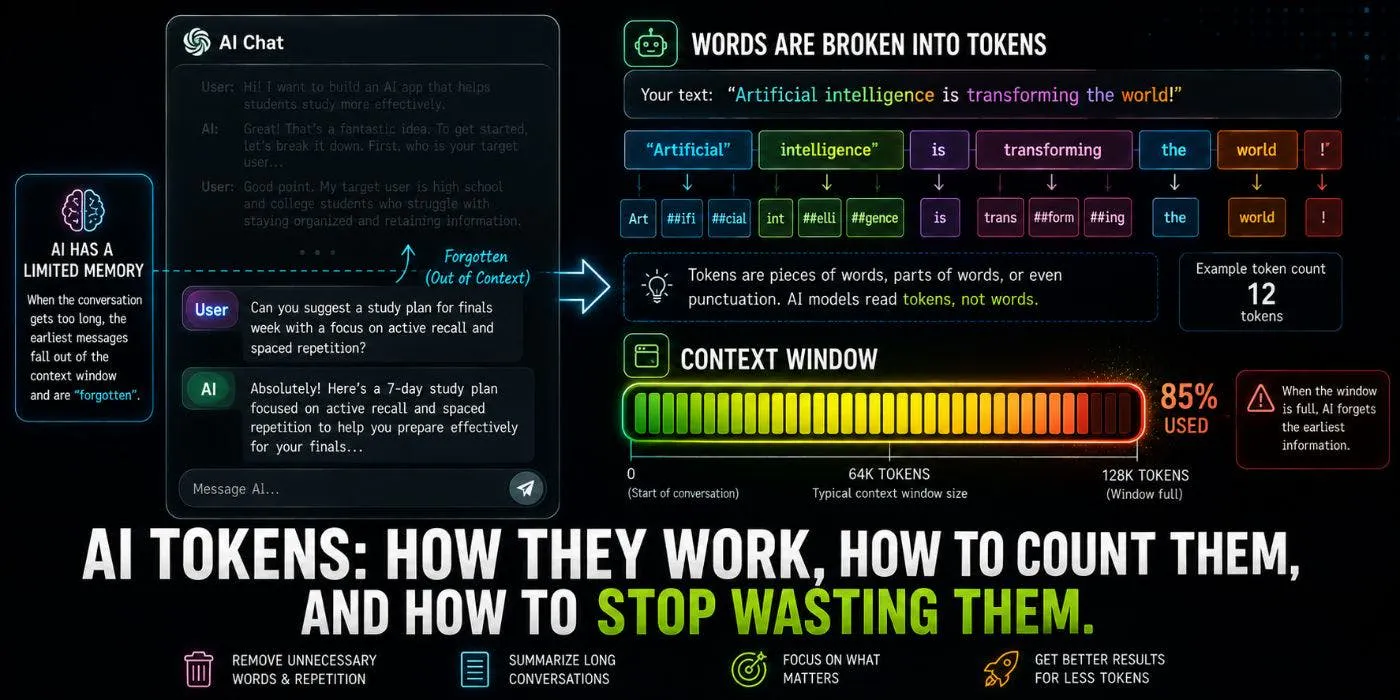
If you run an AI-powered startup from a crowded workstation in Gbagada or a quiet incubator in Akure, you already know the sinking feeling. Your MVP works, your early users love the wrapper, and then the end-of-month API invoice arrives looking like a typographical error.
The central thesis of this breakdown is simple: The interesting thing about AI costs is not that models are expensive. It is that most founders are burning capital because they treat tokens like English words instead of the binary translation units they actually are.

The First Story vs. The Second Story
The First Story: Emmanuela Opurum’s guide on HackerNoon walks through the mechanics of tokenisation—how human text gets chopped up into fragments, punctuation marks, and sub-words like "Chat", "G", "PT" before a model can compute a single response. It is a solid primer for anyone wondering why a 20-message conversational loop suddenly develops amnesia or why bills spiral out of control.
The Second Story: This is a unit economics failure mode hiding in plain sight. Founders are scaling features without auditing their prompt architecture. When you push raw, unstructured context into an LLM on every API call, you are paying a tax on verbosity, inefficiency, and architectural laziness. In an environment where every dollar counts against your runway, bloated token usage is the silent killer of early-stage SaaS margins.
The Builder's Lens: How Tokenisation Actually Bleeds Your Cash
Let's look at the engineering reality. Models do not read sentences; they read integers mapped through a vocabulary matrix. When you pass a prompt like "ChatGPT is surprisingly good at writing code.", the tokenizer fractures it into discrete numerical identifiers.
Every single chunk—punctuation included—adds to your context window weight. If your application architecture appends the entire chat history to every single API request to maintain conversational state (the naive approach), your input token count scales quadratically, not linearly.
Message 1: [Context A] = 500 tokens
Message 2: [Context A + User Query + Response + New User Query] = 1,400 tokens
Message 3: [Context A + All Prior History] = 2,800 tokens
Multiply that across hundreds of active users during peak hours, and your backend is essentially setting cash on fire to re-read things the model already processed two minutes ago.

Strategic Advisory Breakdown
## The Short Answer
Your AI bills are high because you are sending too much redundant context on every request. Fix your state management, stop passing full conversation histories blindly, and start treating token budgets like database query optimization.
## What Is Really Happening
You are treating an LLM like a persistent database. It is not. It is a stateless function that requires you to feed its own memory back to it on every invocation. Every time you send uncompressed history, you pay input token prices for data the model has already analyzed.
## The Assumption I'd Challenge
The part I would challenge is: "We just need to wait for OpenAI or Anthropic to drop their API prices." You may be optimizing for the wrong metric. Even if token costs drop by 50%, inefficient prompt architecture and unoptimized context windows will still bloat your bills as you scale user acquisition. Fix the plumbing before you turn on the tap.
## The Strategic Options
- The Naive Approach: Keep appending full chat histories to every API call. (Result: High churn, margin collapse, Sapa visits for your bank account).
- The Vector/RAG Approach: Store chat history in a vector database or lightweight cache, retrieving only semantic chunks relevant to the current user intent.
- The Sliding Window/Summary Approach: Summarize past conversation turns into a compact state object once a thread exceeds a certain token threshold.
## My Recommendation
Implement a hybrid context manager immediately. Use a rolling summary for older conversational turns and a strict sliding window for the last 4-5 messages. Combine this with local caching for static system prompts.
## What I Would Do Next
- Open your API dashboard today and audit your token input-to-output ratio. If your input tokens dwarf your output tokens by a factor of 10x+, your context management is broken.
- Refactor your backend middleware to truncate conversational history automatically.
- Adopt "No gree for anybody" discipline on your infrastructure costs—test every prompt against a smaller, cheaper model before defaulting to flagship frontier models.
## What Would Change My Mind
If model providers introduce true, low-latency native server-side memory caching that drops input costs for redundant history by 95% across the board, then client-side context engineering becomes less critical. Until then, you own your token bills.
Related from Tech
Let's build your next big product.
Accepting project-based freelance, remote engineering roles, and hybrid positions.