AI Memory Needs to be Boring (And Why That's Great News)
LLMs are stateless by default, and hacking memory into agentic workflows is usually a mess. It's time we start treating agent memory like standard plumbing.
Nothing ruins a good product demo quite like an AI agent that suffers from sudden amnesia.
Last month, I was tweaking a customer service agent for an e-commerce merchant handling orders across Onitsha. The user asked a simple follow-up question about an order they mentioned two messages prior, and the bot completely blanked out, asking for their phone number again like a confused stranger.
That experience is the direct consequence of how LLMs are built. They're stateless. Every single call to an API endpoint starts from zero unless you manually craft a way for the system to remember.

Stop Conflating the Context Window with Memory
Alejandro Saucedo recently published the first part of a series on building multi-tenant agent memory, and one specific quote hit me right where it hurts: “Let’s make the memory layer BORING, so that the agents can continue to be the fun part.”
He hits the nail on the head regarding a mistake almost every developer makes when starting with AI tools: we conflate context windows with actual memory.
Throwing thousands of raw tokens into a huge prompt context window isn't "memory"—it's expensive working memory that gets wiped clean the moment the API request finishes. Storing raw chat logs in a Postgres table isn't memory either; that's just an audit transcript.
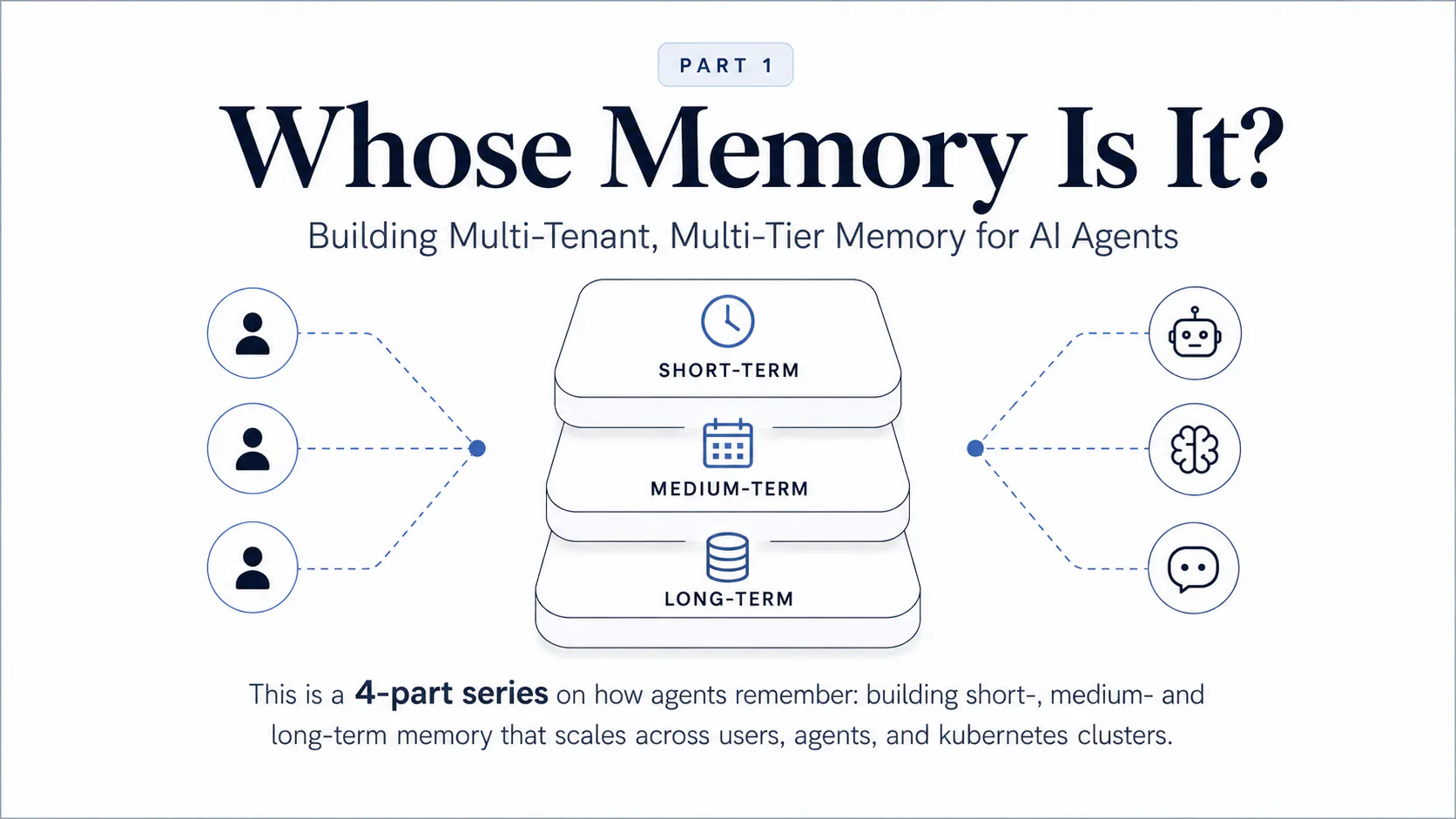
True agent memory requires structure. It needs to handle different lifetimes:
- Short-term memory for the immediate task or session.
- Medium-term memory for recent state transitions and ongoing sub-goals.
- Long-term memory for persistent user preferences, facts, and past resolutions that shouldn't disappear when the server restarts or when generator light trips at the office.
The Tooling Explosion is Overwhelming
If you've looked at the ecosystem over the last six months, you know it's getting chaotic. Every morning there’s a new memory framework dropping on GitHub.
Between Mem0, Zep (and Graphiti), Letta (formerly MemGPT), Cognee, Memobase, and native agent state in LangGraph or CrewAI, developers are spending more time writing custom integration scripts than actually shipping features.

When I'm sitting down at a quiet workstation in Akure trying to build production-grade workflows, I don't want to reinvent vector indexing or build custom TTL eviction policies every time I launch an agent. I want memory to work like Redis or a standard SQL database—predictable, boring infrastructure.
Whose Memory Is It Anyway?
The biggest hurdle comes when you move from single-user experiments to multi-tenant software.
If you are running agents for multiple clients, data isolation isn't optional. You can't have Tenant A’s agent hallucinating details from Tenant B’s support history because both were sharing the same vector namespace without proper scoping.
Saucedo's research into roughly 30 tools highlights why we need standardized abstractions:
- Tiering: Clear boundaries between short, medium, and long-term storage.
- Scopes: Bulletproof isolation per user, per agent, and per organization.
- Degradation & Folding: Automatic summarization and decay so vector stores don't explode in cost over time.
Where We Go From Here
We are finally moving past the phase where building an AI app means writing a 500-line Python script full of fragile string manipulations and manual vector upserts.
Treating memory as distributed Kubernetes-level infrastructure (like Saucedo's work on KAOS) is the direction the industry needs to go. Once we solve memory persistence at the infrastructure layer, we can spend less time fighting stateless APIs and more time building software that actually solves real everyday problems for users.
Related from Tech
Let's build your next big product.
Accepting project-based freelance, remote engineering roles, and hybrid positions.