Hyperscale Hype vs. My Gen-Set: The Realities of Building for 400 Million Nigerians
Big money is pouring into Lagos data centers, promising shiny new AI and cloud hubs. But as a developer wrestling with latency and fuel prices, I have to ask: who is actually going to power all of this?
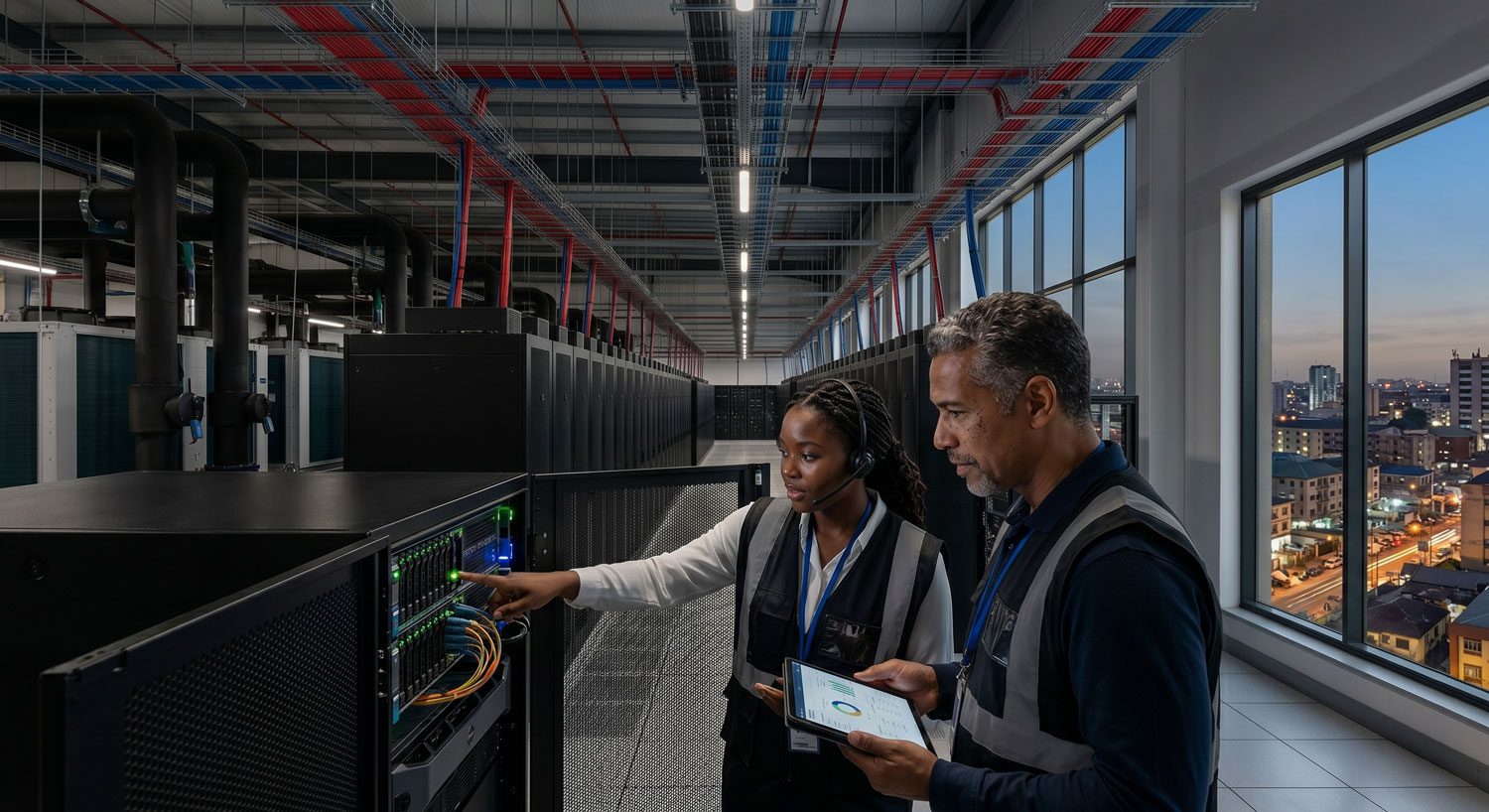
The generator at my shared workspace in Gbagada just did that familiar, violent shudder before roaring to life. For three seconds, the Wi-Fi dropped, my terminal froze, and my SSH connection died. Just another Tuesday. I was right in the middle of deploying a lightweight database for a client, cursing the latency that always seems to spike whenever I try to push code to a server sitting somewhere in northern Virginia.
So when I see headlines about the massive $1 billion data center bets being placed on Nigeria, my developer brain does a quick double-take.
On paper, the numbers are dizzying. We are 240 million strong, heading toward 400 million by 2050. The median age is 18. Investors at the African Energy Chamber are looking at us and seeing a gold rush. Companies like MTN are putting $240 million into AI-ready facilities, and Equinix is throwing millions at their LG3 facility in Lagos.
But as someone who actually writes the code that is supposed to run on these machines, I have some thoughts.
The Latency Tax is Real
If you have ever built an app for a vendor in Onitsha or a student in Akure, you know the absolute pain of the "latency tax."
Right now, almost every hobby project, fintech MVP, and SaaS tool built by local devs is hosted on Heroku, Render, Supabase, or AWS. None of these providers have physical nodes here. When a user in Owerri tries to log into an app, their request has to travel through underwater cables across the Atlantic to Dublin or Ohio and back, just to check if their password is correct.

If these new hyperscale facilities by Rack Centre and Open Access Data Centres mean we can finally get sub-10ms ping times locally, it changes everything. We could build real-time collaborative tools, snappy local gaming servers, and voice-activated AI tools that don’t lag like a bad WhatsApp call on a rainy day.
Great, But Who Pays the Diesel Bill?
Here is the catch, and it’s a big one.
These data centers are energy hogs. A 24MW facility in Lekki sounds incredibly futuristic until you realize it has to run 24/7/365. In a country where the national grid collapses if someone sneezes too hard near a transformer, these operators are going to rely heavily on industrial-scale gas turbines, massive solar arrays, and thousands of liters of diesel.

If the cost of keeping the lights on in these data centers is astronomical, then local cloud hosting is going to be incredibly expensive.
If hosting a simple Node.js API inside a Lagos data center costs me three times what it costs to host it on a digital ocean droplet in Frankfurt, guess where I am keeping my code? The average Nigerian developer is already dealing with the "Sapa" struggle; we are not going to pay a premium for patriotism if it kills our runway.
What This Actually Means for Local Builders
Despite my skepticism about the power grid, I cannot help but feel a bit of that "No gree for anybody" energy when looking at these investments.
We have a massive, hyper-connected youth population that is basically mobile-first. They do not use desktops. They do everything on entry-level Android phones, navigating the chaotic digital economy with sheer grit.
If this $1 billion infrastructure bet actually democratizes access to cheap local cloud compute, we will see a massive shift. We won’t just be building wrappers around US-based APIs anymore. We will actually have the infrastructure to train localized AI models, handle high-throughput local payments without constant timeout errors, and build software that fits the unique, chaotic, and beautiful flow of Nigerian life.
The infrastructure is coming. Now, let's just hope the power stays on long enough for us to deploy.
Related from Venture
Let's build your next big product.
Accepting project-based freelance, remote engineering roles, and hybrid positions.