On-Chain Risk Engines: Can We Actually Build Usable Prediction Markets?
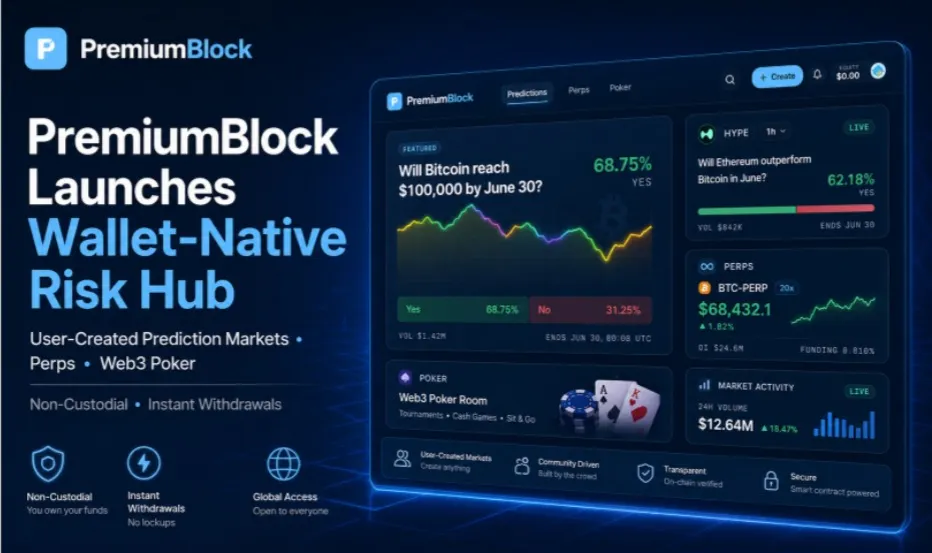
PremiumBlock just dropped their non-custodial risk hub. As a dev who has spent too many nights fighting RPC latency, I wanted to see if this solves real execution problems.
My generator has been humming for the last four hours because the grid decided today of all days to show us pepper. My brain is already fried from debugging smart contract event listeners that refuse to sync, but this news about PremiumBlock launching a non-custodial risk hub caught my eye.
They are promising a framework for user-created prediction markets, perpetuals, and Web3 poker. As a developer, my immediate reaction is a mix of genuine curiosity and healthy skepticism.
Building peer-to-peer risk infrastructure is easy on a whiteboard. It is a completely different beast when you deploy it to mainnet and real money is on the line.

The Real Problem With User-Created Markets
Most decentralized prediction markets fail because of liquidity boot-strapping and oracle disputes. If I want to set up a small, hyper-local prediction market for my friends—say, betting on whether a new co-working space in Akure will open on time next month—how do we resolve the outcome without relying on a centralized referee?
PremiumBlock’s pitch is a shared, non-custodial liquidity layer. Instead of every creator building their own risk engine from scratch, you plug into their hub.
From an SDK perspective, this is smart. I love anything that abstracts the heavy math of margin requirements and collateral pools. It lets us focus on building a clean user interface.
But user-created markets are messy. If the data source feeding the contract fails or gets manipulated, the smart contract does not care about your intentions; it only executes the code. Handling disputes programmatically without a centralized backdoor is incredibly difficult to pull off.
Latency, "Sapa," and the Mobile Web3 Reality
Let us talk about the user experience. If someone is trading perpetuals or playing a hand of Web3 poker on this protocol, they expect instant feedback.
Our reality here is that we are often building for users dealing with flaky mobile data while sitting in a commercial bus in the middle of traffic. If a user has to sign three different ledger transactions and wait for block confirmations just to fold a poker hand or adjust a leverage position, they will close the tab.

To make this risk hub viable for actual retail users, devs using their SDK will have to lean heavily on account abstraction (ERC-4337) and session keys. Users need a Web2-like experience where gas fees are sponsored or paid in stablecoins, and transactions happen in the background.
The "No gree for anybody" mindset applies to software too. If your decentralized app is sluggish, users will not pity your elegant smart contract architecture. They will simply delete your bookmark and go back to WhatsApp-based sports betting groups where settlement is instant, even if it is custodial.
How I Plan to Test This
I am tempted to spin up a quick proof-of-concept using their SDK. Maybe a micro-prediction app for my local dev community to hedge against fuel price hikes or predicting the exact time the power grid collapses next week.
If their contracts are clean, the documentation is readable, and the integration does not require jumping through twenty different cross-chain bridges, they might actually be on to something.
But until I see how their risk engine behaves under a sudden market crash or an oracle failure, I am keeping my guard up. Building the backend is only half the battle; keeping it secure and fast enough for everyday people is where the real work begins.
Related from Tech
Let's build your next big product.
Accepting project-based freelance, remote engineering roles, and hybrid positions.